
A hot morning at the old stone house was interrupted by the arrival of a letter. My great-grandmother Tone was overcome with emotion when she saw that the sender was her brother Mate, her curiosity drawn to the postage stamps and the words written in Spanish. Gathering her children around the table, she told them about the letter the postman had delivered on the back of his donkey. Barba Mate was writing from Punta Arenas: work was plentiful in those cold southern lands, and the Dalmatian clubs had grown stronger with the years, bringing together fellow countrymen who had settled where the map comes to an end.
Money was gathered for the ticket, and without much discussion, fifteen-year-old Petar’s life began to unfold in another country, beneath a different sky, in a different climate, and in a different language. There was a heartfelt farewell embrace with his family and a promise made to his sister Karmela—that they would always write to one another.
After saying goodbye, Petar boarded the Martha Washington in Split. Many ports, many cities, and, above all, endless stretches of sea lay ahead before he finally arrived in the Port of Buenos Aires in October 1929. From there, he embarked on the final leg of his journey to Magallanes.
Having learned the skills of shepherding at an early age in Gažul—the traditional occupation of the Gospodnetić family, known by the nickname Bežmek—Barba Mate had found the perfect job for his nephew: a shepherd’s assistant on a sheep ranch on Isabel Island. Life there was dramatically different from what he had known on the Island of Brač. The Patagonian plains were covered with unfamiliar grasses, and even the sheep were British breeds. My grandfather Petar therefore spent the rest of his life longing for the familiar aromas and flavors that had accompanied every family gathering in his native village.
Yet the promise the brother and sister had made to each other was faithfully kept—they wrote to one another throughout their lives. Their correspondence reflects the transformations of the twentieth century: at first, letters traveled for months by ship; later, advances in air travel allowed them to arrive much more quickly. Through those letters they shared news of marriages, the births of children and grandchildren, and the heartbreaking losses of loved ones.
My grandfather never returned to his island. Instead, his children and grandchildren made that journey, reconnecting with our roots and our relatives, fulfilling the dream that he and his sister had always cherished—that we would never forget the unbreakable bond that connects us, because blood is thicker than water.
In 1994, the brother and sister accomplished what had seemed impossible for decades—they spoke by telephone. After more than sixty years of exchanging letters, they finally heard each other’s voices. I like to imagine the excitement they both felt before that call. My grandfather must have had countless questions, knowing the hardships endured by those who had remained in Europe. Karmela, in turn, understood how harsh life was at the far end of the world, having heard the stories of those who could not withstand Patagonia’s unforgiving cold and eventually returned home.
Even so, I picture them smiling with that unmistakable Dalmatian sparkle in their eyes as she answered the phone and said:
“Dear brother Pere, is that really you? Why, you still sound like a little boy!”
Author: Pedro Gospodnetic
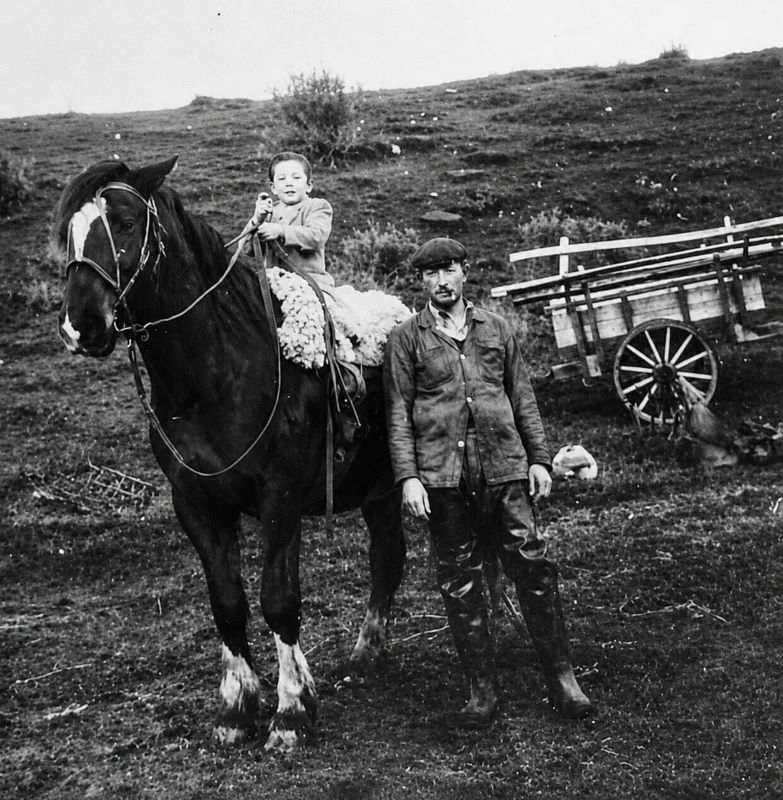
Grandpa Petar on the Mata Grande farm in 1950
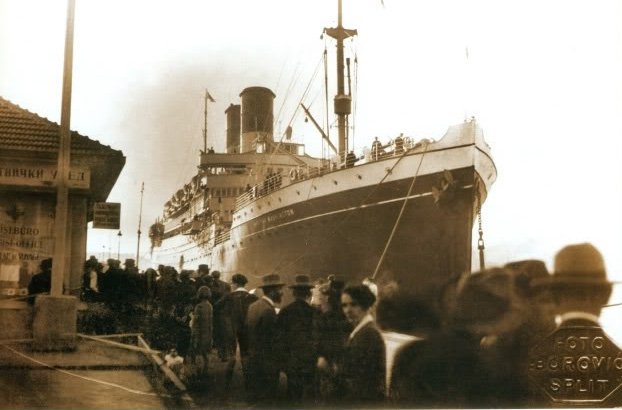
SS Martha Washington in the port of Split in the 1930s (photo by Ante Borović)