
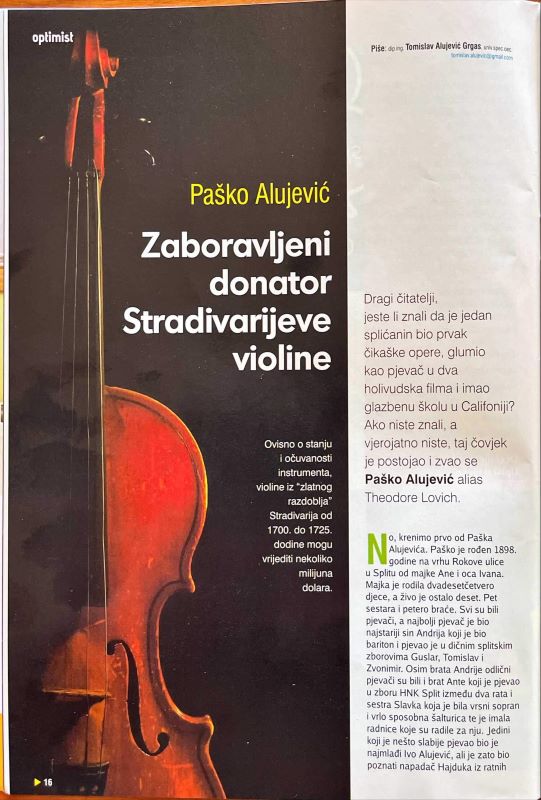
Paško Alujević was born in 1898 in Split, to Ivan Alujević and Ana, née Dvornik. Ana’s father, Paško, owned a tavern and was a fervent supporter of the National Party. Painted proudly on the tavern ceiling was a Croatian flag with the checkerboard emblem.
Ana and Ivan had a large family. According to Tomislav Alujević Grgas, Ana gave birth to twenty-four children, ten of whom survived to adulthood. Paško thus had four brothers and five sisters. Among them, the brothers Andrija and Ante stood out for their exceptional musical talent.
Andrija and Ante sang in the Split choirs Guslar, Tomislav, and Zvonimir, as well as in the choir of the Croatian National Theatre in Split. They were also skilled hunters.
Ante married Marija Kragić, the daughter of one of Split’s respected landowners, who—interestingly—had been expelled from school because he refused to read and write in Italian, insisting instead on using Croatian. Her father, Jure Damjan Kragić, was not enthusiastic about giving his only daughter in marriage, as their well-off farming family did not consider themselves of the same social standing as the Alujevićs, who were tavern keepers. Marija had also graduated from the prestigious school run by the Sisters of Ančela (Sisters Servants of a Little Jesus) in the Dobri district, and her dowry amounted to two kilograms of gold.
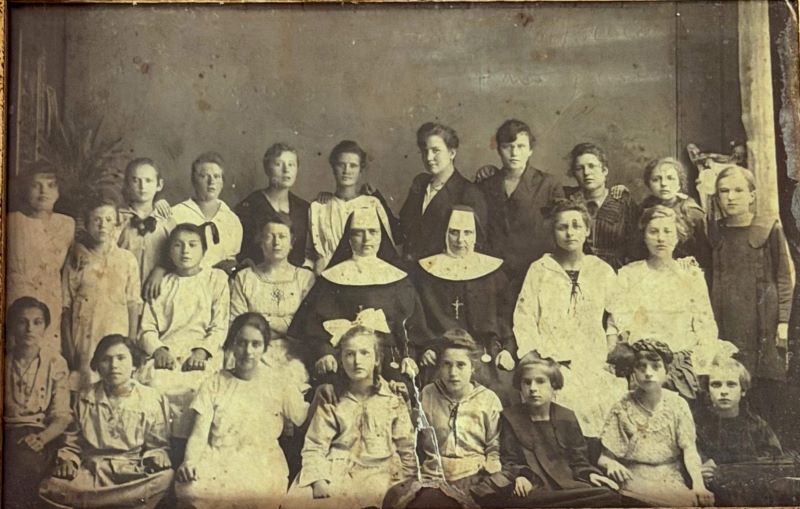
Marica at school (fourt from the right in the first row)
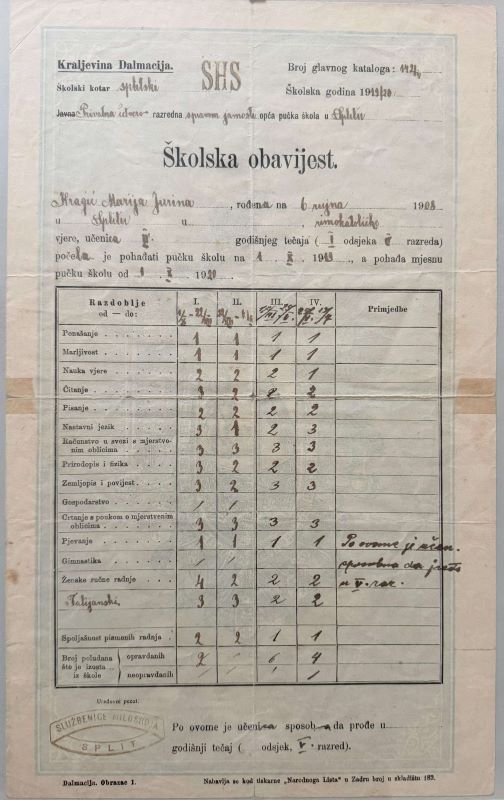
Marica’s school report
Ante was friends with composer Ivo Tijardović, who used Ante’s romantic troubles as inspiration for the libretto of the operetta Splitski akvarel. The names Ante and Marija were changed to Tonći and Marica. One of the operetta’s characters is also Paško, who had already emigrated by then, as Tonći mentions the dollars he sends from America.
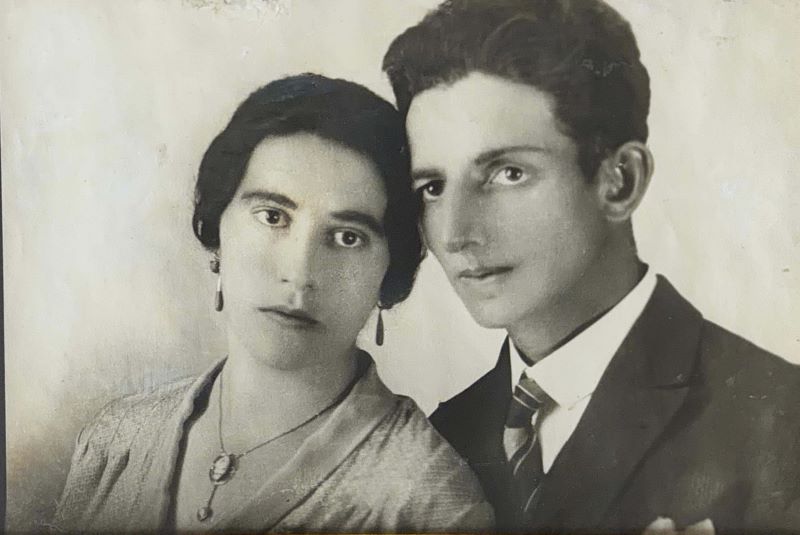
Ante and Marica as fiancés
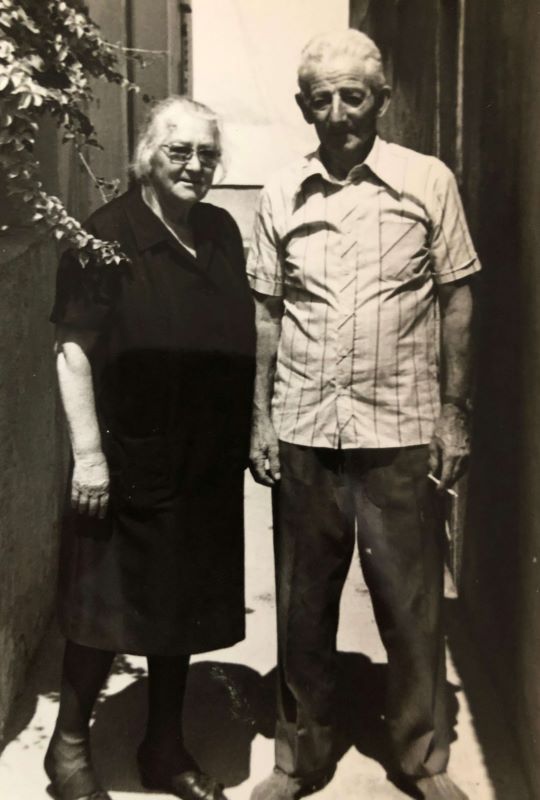
Ante and Marica
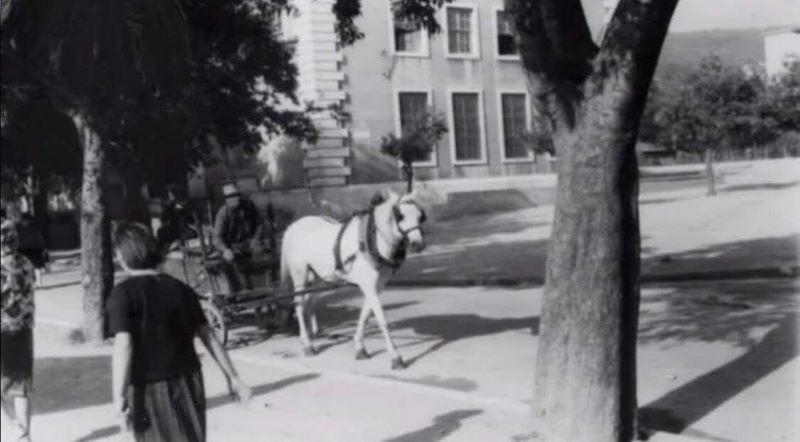
Ante and his horse
One of the sisters, Slavka Alujević, was an accomplished soprano and a respected dressmaker. The youngest brother, Ivo Alujević (born 1914), was a less gifted singer but gained recognition as a forward for the Split football club HNK Hajduk Split in the pre-war and wartime years.
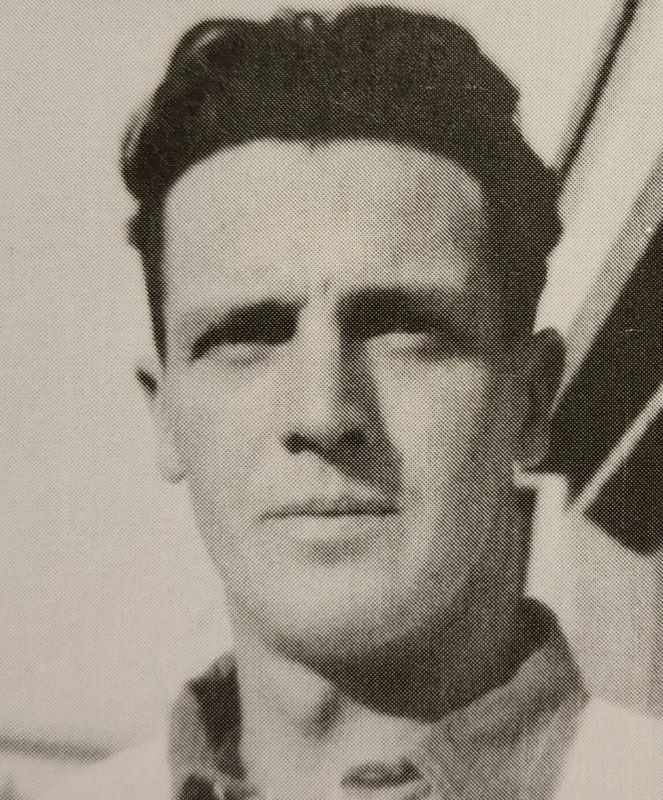
Ivo Alujević
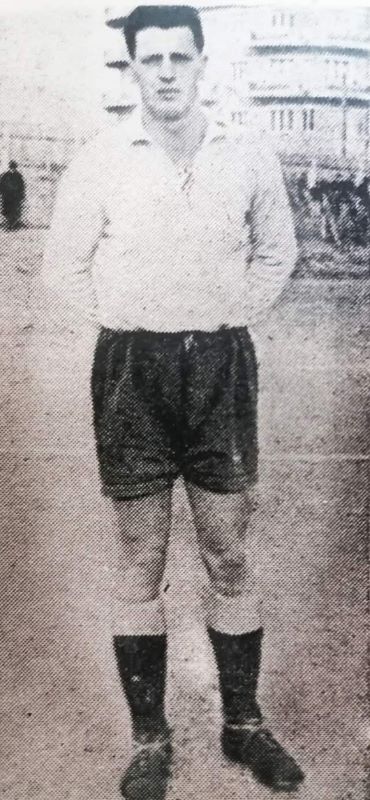 Ivo as a soccer player
The family lived in the Lučac district of Split. A close family friend was composer and conductor Josip Hatze, who frequently visited their home on Rokova Street, where, as he liked to say, he had his own small “chamber choir.” As a true musician, he could not resist conducting such a family ensemble. At the age of seven, Paško’s father sent him to sing in the boys’ choir of the Church of St. Peter, which was later destroyed during World War II.
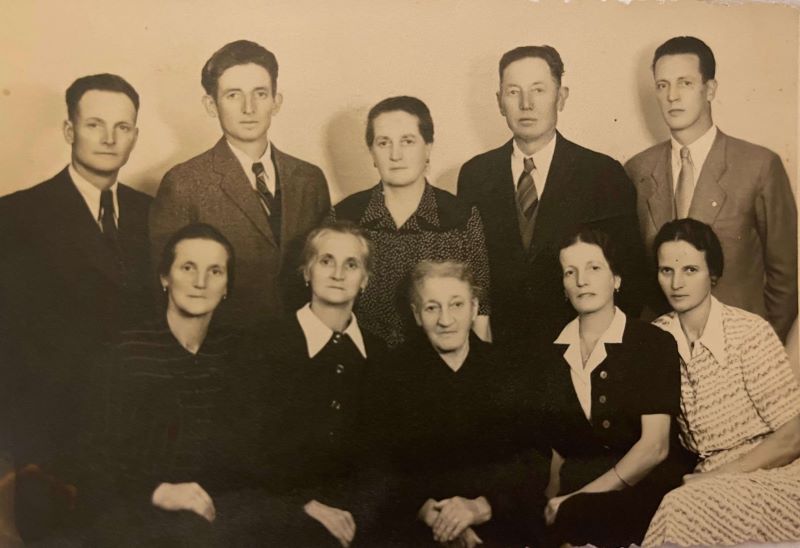
The Alujević Family
Of all the children, Paško was the only one who chose to venture out into the world. His family supported him by selling part of their land to fund his journey. In 1923, he went to Trieste intending to travel to North America. However, due to a misunderstanding with a friend assisting him, he was mistakenly put on a ship bound for Montevideo instead of the United States. At the time, however, all overseas destinations were commonly referred to simply as “America.”
In Montevideo, he initially worked in cold storage facilities and later in a chocolate factory, though he did not stay long with any single employer. One day, while passing by a cathedral from which singing could be heard, he approached the choirmaster—an Italian—after Mass. The choirmaster offered him a job as a gardener and a place in the choir, while also teaching him singing. This encounter proved decisive for his future artistic path.
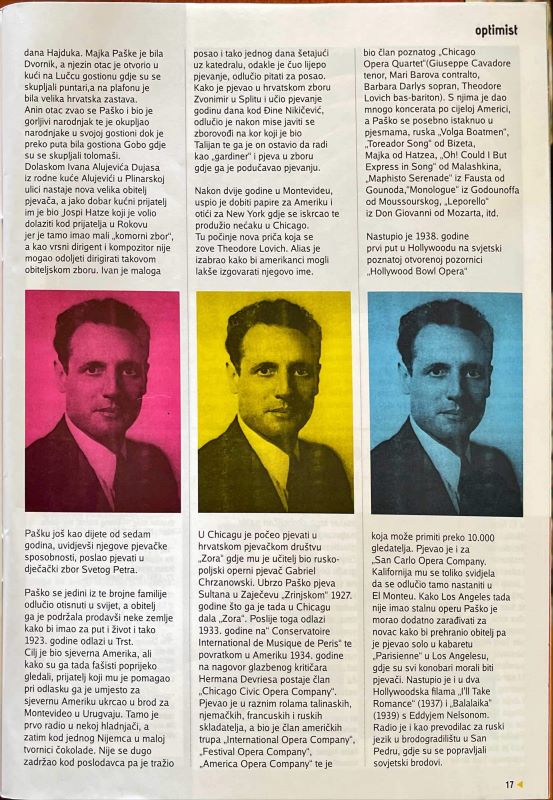
After two years in Montevideo, Paško managed to obtain the necessary documents and moved to Chicago. There he began a new chapter in his life and changed his name to Theodore Lovich. In Chicago, he sang with the Croatian choral society “Zora,” where his teacher was the Russian-Polish opera singer Gabriel Chrzanowski. As early as 1927, Paško performed the role of the Sultan in the opera Nikola Šubić Zrinjski by Ivan pl. Zajc, staged in Chicago by the “Zora” society.
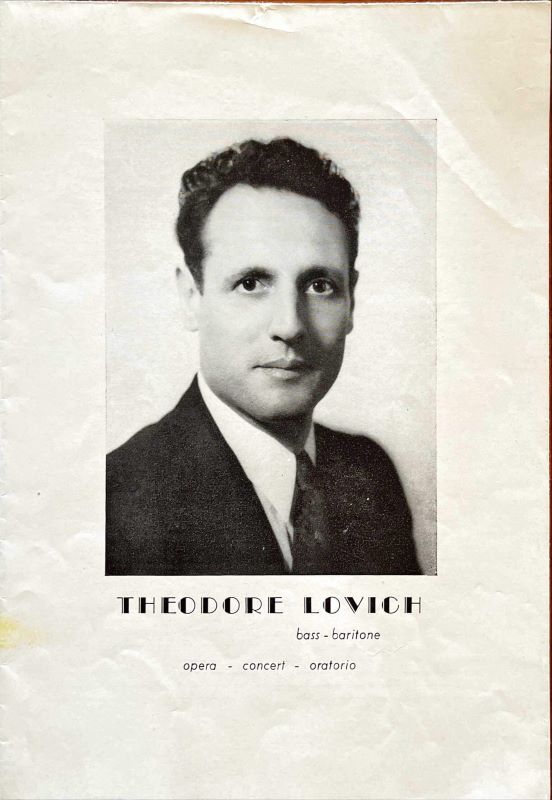
Paško, now Theodore in the USA
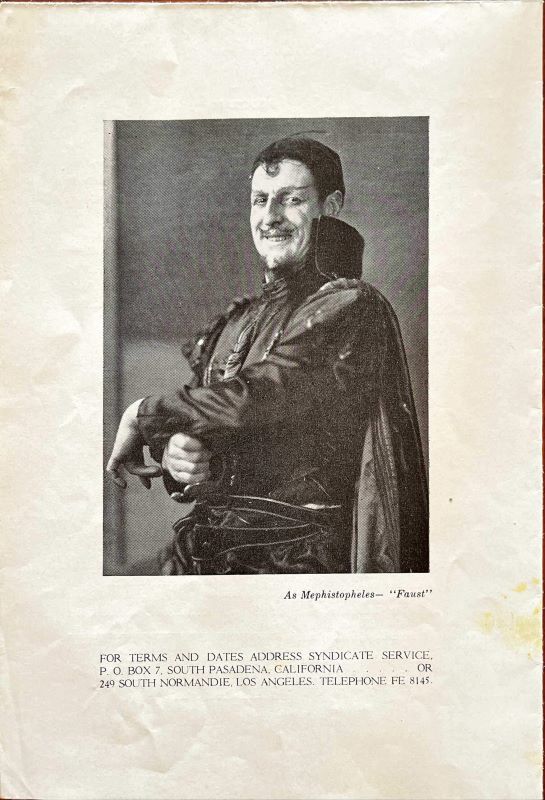
In 1933, he went to further his studies at the Conservatoire International de Musique de Paris, and upon returning to the United States in 1934, he became a member of the Chicago Civic Opera Company. He performed numerous roles from works by Italian, German, French, and Russian composers. He was also a member of the opera companies International Opera Company, Festival Opera Company, and America Opera Company, as well as the distinguished ensemble Chicago Opera Quartet (Giuseppe Cavadore, tenor; Mari Barova, contralto; Barbara Darlys, soprano; Theodore Lovich, bass-baritone).
The American press devoted considerable attention to him in the mid-1930s. Herman Dervies of the Chicago American (November 13, 1934) praised Paško’s (Lovich’s) debut, writing that he was a bass-baritone from whom much was expected.
Numerous newspaper reviews followed:
“During the June performance of Gounod’s Faust at Kimball Hall, organized by the ‘International Grand Opera Company,’ the remarkable talents of this distinguished Croatian baritone came fully to the fore. He demonstrated exceptional acting ability… brilliant vocal power and authority.” — Novi Svijet, February 1932.
“Theodor Lovich distinguished himself in one of the smaller roles, that of the Doctor, as a discreet and imaginative artist.” — Eugene Stinson, Chicago Daily News, November 15, 1934.
“Theodor Lovich, bass, contributed an impressive performance of an aria from Prince Igor (Borodin).” — Musical Leader, July 13, 1935.
“A new voice, that of Theodor Lovich, enchanted the audience last night.” — Courier, Ottumwa, Iowa, March 5, 1935.
“An outstanding performance was that of Theodor Lovich as a truly diabolical Mephisto.” — Joplin Globe, February 28, 1935.
“The Chicago company brought to Lincoln a cast composed entirely of stars… Theodor Lovich, bass, who excelled in the role of the King of Egypt, and Reinald Werrenrath, the well-known baritone…” — Lincoln State Journal, May 7, 1935.
“Theodor Lovich as Mephistopheles proved himself the possessor of a powerful, resonant voice, easily capable of ominous domination of the stage at every appearance.” — Salina Journal, February 21, 1935.
“Mr. Lovich made a strong impression with his interpretation of compositions by Manna Zucca (‘I Love Life’) and Bruno Huhn (‘Invictus’). His powerful bass-baritone was elevated by his dramatic abilities.” — South Bend Tribune, February 19, 1936.
“American critics have often mentioned and praised the Yugoslav singer Theodor Lovich, and rightly so; last Friday he received ovations in The Bartered Bride in the role of Michu.” — Nedělní Svornost, December 6, 1936.
“Lovich, celebrated for his roles in Faust and Martha, offered an ideal bass-baritone… His interpretation of ‘The Volga Boatmen’ brought freshness to that well-known Russian song.” — Mining Journal, Marquette, Michigan, February 26, 1936.
“A crowd estimated at 24,000… listened to the equally impressive Theodore Lovich in the role of the Bonze, a majestic and awe-inspiring priest.” — Isabel Morse Jones, Times, August 27, 1937.
“Theodor Lovich greatly contributed to the brilliance of the performance… he succeeded both musically and dramatically.” — Cedar Rapids Gazette, May 6, 1937.
“Theodore Lovich was convincing as the Egyptian king; he developed his role in a way that truly served the whole.” — Carl Bronson, L. A. Evening Herald-Express, February 19, 1938.
“He achieved tremendous success at his second concert. The program was excellent, and the voice rich and artistically shaped. His finest performances were the ‘Monologue’ from Mussorgsky’s Boris Godunov and the ‘Leporello’ aria from Mozart’s Don Giovanni.” — Yugo-Slav Herald, San Francisco, January 15, 1938.
“The concert was so well attended that only standing-room tickets were issued. The engaging program, which included arias from beloved operas and songs in English and Slavic languages, was performed brilliantly by the artist.” — News-Pilot, San Pedro, February 18, 1938.
Our Paško, now Theodore, first performed in Hollywood in 1938 at the famous open-air venue Hollywood Bowl. He liked California and settled in El Monte. Since Los Angeles did not yet have a permanent opera house at the time, he supplemented his income by singing as a soloist in the cabaret “Parisienne,” where all waiters were required to be singers. He also appeared in two Hollywood films, I’ll Take Romance and Balalaika, and worked as a Russian-language translator at a shipyard in San Pedro, where Soviet ships were repaired.
After World War II, he opened a music school and a vocal training studio in El Monte.
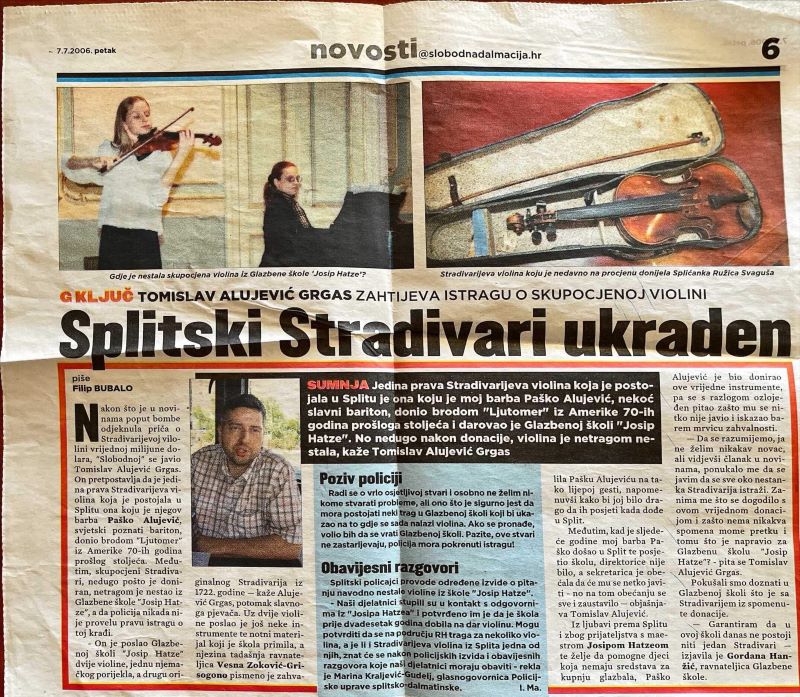
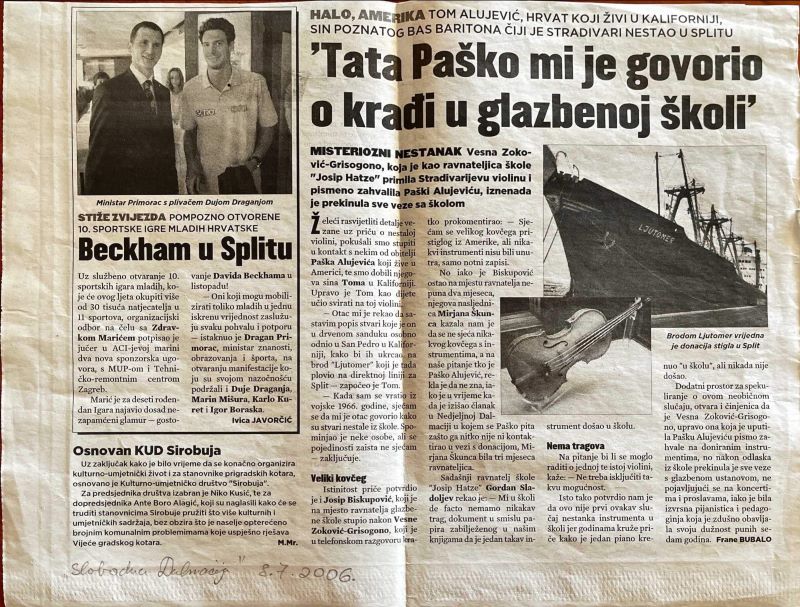
In the late 1960s, he decided to donate the sheet music and instruments he had collected over the years to the Josip Hatze Music School in Split. The shipment was transported by the ship Ljutomer from San Pedro directly to Split. His son, Tom Alujević, compiled an inventory of the items sent in a wooden crate: a large quantity of sheet music, a new trumpet, and two violins—one German-made and the other, reportedly, a Stradivarius violin from 1722.
Upon the shipment’s arrival, Paško received a letter of thanks from the school along with an invitation to visit upon returning to Split. Unfortunately, over time the violins and other instruments were lost, and they are no longer part of the school’s holdings. Those who had witnessed the events were unable to clarify the circumstances of their disappearance.
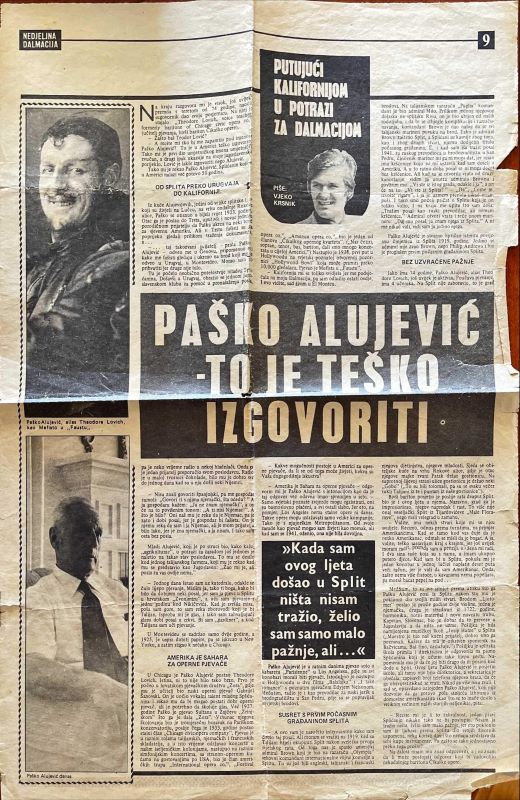
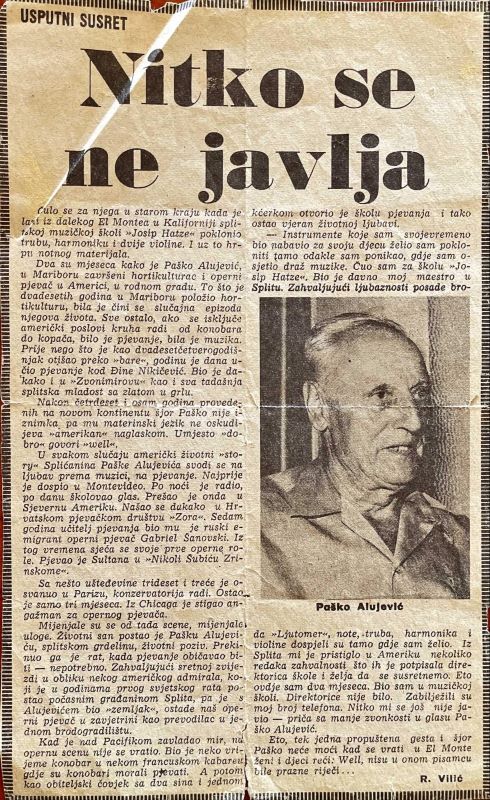
After this disappointment, Paško Alujević never returned to his hometown.
He died in 1984 in California, where he was also buried.
Information and photos courtesy of: Neven Alujević
Edited by: Branka Bezić Filipović